After months on the campaign trail through the liberal streets of Somerville, Mass., local socialists watched as votes trickled in and fell short of the city’s progressive promises.
The burgeoning city bypassed a historic opportunity to vote a socialist city council into office on an Election Day overshadowed by the clash between the corporate and working classes playing out in Somerville’s neighborhoods.
Situated in the Democrat-dominant Boston area, Somerville is a microcosm of liberal conflict. This year, Boston Democratic Socialists of America endorsed seven candidates for the Somerville City Council race. If all seven candidates had won, the city would have become the first municipality in the country with a democratic socialist majority in the city council.
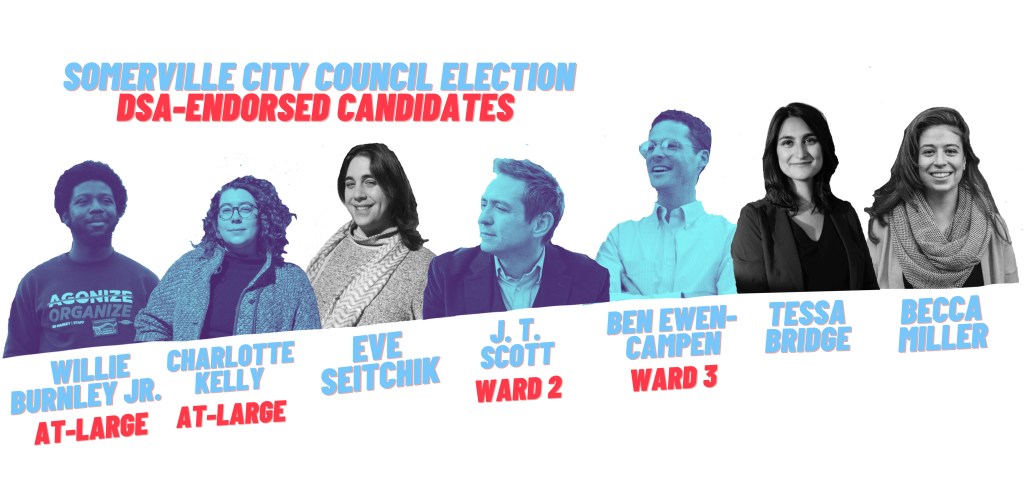
As voting stations closed, just four of the DSA candidates claimed victory. Instead of a unanimous city council painted with the same DSA seal of approval, the 30% of registered Somerville voters who hit the polls pushed for a slate of Democratic winners that favored relatively mainstream liberal positions and echoed the umbrella “progressive” population’s debate in answering the question, “How far left?”
Socialist volunteers like resident Caro Fett knocked door to door through their hometown Somerville, spurred on to canvass for the boldest progressive candidates by the growing gap between their city’s promises of equity and its economic reality.
“The city government isn’t working for the people who need it most, i.e. low-income people, immigrants and people of color,” Fett said.
More than a third of Somerville households spend over 30% of their income on rent or mortgage payments, and recovery from the COVID-19 pandemic oversaw a sharp increase in housing and living costs that many working people cannot keep up with.
“It’s scary and sad because I’ve definitely heard people talk like, ‘I moved to Somerville this long ago. This is not what I signed up for when I decided to raise my family here, or when I decided to put down my roots here,’” Fett said, echoing the concerns of many Somerville residents she met while canvassing.
The divergence between the city’s progessive ideals and practical reality is part of a broader phenomenon in increasingly gentrified urban areas like Somerville, where liberal voters support an economic and class infrastructure that interferes with their political proclamations.
“In Somerville we have a lot of development,” Fett said. “Specifically these labs like Greentown Labs- people who make a fair amount of money doing, quote, ‘environmental work,’ but they partner with companies like Exxon.”
Multi-million and billion dollar developers like Greentown Labs, who broadcast greenwashed images of climate action backed by industrial giants, and 2018’s Federal Realty Investment Trust, who completed a luxury housing installation that ignored the city’s mandated affordable housing ratio, paint a picture of a falsely equitable Somerville that can be achieved through corporate sponsorship, the antithesis to the socialist movement.
This struggle to balance economic growth with equity is not unique to Somerville. American urban progressivism has a historic contradictory tendency to promote capitalist interests while still harboring the desire to protect the working class. In the Boston area in particular, political powers continue to recognize real estate interests as engines of social growth.
As “growth” takes precedence over equity and social justice in growing liberal cities like Somerville, rather than a cohesive, mobilized socialist movement, modern progressivism instead yields policies that undermine its foundational values.
Although Somerville’s leftist expansion is progressing below the speed limit of exact revolution, with 68% of the DSA’s nationally endorsed candidates taking office in this election cycle, socialist activists remain optimistic.
This Nov. 2, Somerville voters elected to take a slow but sure step to the left, part of a grassroots political history designed to start and end with the people, not the powerful.
“We can’t just sit at home and expect our city to be the progressive one that we love. We need to actually work for it, and that looks like organizing, civil disobedience, emailing and calling your elected officials, writing letters, writing op-eds or talking to your friends,” Fett said. “Organizing looks different for everyone, but I think we’ve just got to keep organizing.”
 KARISSA KORMAN